
the time when there is more time
an aside on meditation

A few weeks ago, I finished an eight-day silent course at the Vipassana meditation center in Shelburne Falls, Massachusetts1. I’ve never written anything at length about my relationship to meditation because it has felt beside the point—the point being the practice—but if you know me personally, then I’ve likely proselytized or at least mentioned it to you. It has been a deeply important part of my life for nearly thirteen years, and I thought, as I sat this recent course, maybe that’s worth noting. It’s a subject about which I have a lot to say, and to be upfront, I do think everyone should do it.
I first learned about Vipassana from my friend Sam. When we were both 18, I started college and he rode his bike across the country and down nearly the entire Pacific coast. Then he sat his first course and effused about it in a letter he sent to me at school. Ten days of silence, that sounds really intriguing, I thought. Then I went back to doing a lot of drugs, drowning in abstruse texts and grappling with exhilarating new abstractions, and doggedly suppressing a lot of grief and trauma.
The Vipassana idea didn’t chime again until I took my second leave of absence from school. I was hanging around Portland before I left for good, and I brought it up offhand to my friend Clemmie. As it so happened, she had returned from her first course a few months prior. She described visualizing her consciousness as a cup and realizing that, while she had previously associated herself with the contents of the cup—poured in and out, depleted, polluted, consumed, replenished—she was actually the vessel itself, and it was her task to keep it as clean and durable as possible. This didn’t really make sense to me at the time, but I was struck by the coincidence, and she urged me to go.
So I sat my first course at Dhamma Dharā in October 2012 without having meditated for a second in my life to that point. On a Vipassana course, a gong wakes you up at 4, and starting at 4:30, you clock in ten or eleven total hours of seated meditation over the course of the day. It was excruciating. The shear between the unbelievable physical and psychic pain I was experiencing and the stillness in which I was experiencing it was beyond description.
That was also the week when Hurricane Sandy hit the Northeast. One afternoon in the middle of the course, the sky turned green, and the violent, days-long rainstorm that followed brought down a huge tree in the woods behind the center where the women’s walking paths were. I felt then what I’ve encountered on every subsequent meditation course I’ve sat: whatever the weather, it becomes an absolute reflection of my inner state, as if my emotions were cast in a mold the exact contours of the conditions outdoors. Anyway, I cried myself to sleep every night and promised myself that I would quit in the morning; in the morning, I would wake up and vow to quit before the evening. That was how I eventually arrived at Day 10, and then it was over.
Despite all of that, a few years later, I signed up for another ten-day course in Onalaska, Washington. I had some inkling that there was something I had not fully gleaned from my first crack. Vipassana is taught in the exact same way at every center around the world—same timetable, rules, discourses2, and sometimes, the same food3. It was my second course that stuck with me, the one in which I started to connect the dots between the observation of sensations and the undoing of habituated reactions. I came away from it not changed, but somehow more myself.
From that point forward I’ve maintained some modicum of regular practice—at times quite committed, at others desultory, going long stretches without meditating at all—but conscientiously—and coming back to it with gusto after a course. Daily practice is hard! Doing anything at all—on purpose—everyday—is hard! The path, for me, is an erratic and gappy asymptote toward the advised hour in the morning and hour in the evening.
The time commitment required by Vipassana can and does pose a hurdle. All first-time students are required to sit a full ten-day course; that’s not easy for most people who work. Because of the extensive administrative process involved in coordinating a course, registrations usually open up months in advance, and so much is liable to change in the time between signing up and attending a course, if you’re able to get in—high student demand means most courses fill up quite quickly. But the registrars are accommodating and the waitlists do move, and (this will sound cultish but) they really, really want you to come meditate. If you want to.
One thing I find especially unique about Vipassana—as not quite an institution, exactly, but a codified and organized endeavor—is that there is no upfront cost to attend a course. The only requisites are a desire to learn and a willingness to stay for the full ten days (even if you cry yourself to sleep every night). At the end of the course, meditators have the opportunity to make a donation according to their volition and means. Every Vipassana meditation center in the world is staffed by volunteers and sustained completely, materially, on the generosity and goodwill of meditators, which makes the meditation center as close to a completely non-commercial social space as possible. When I’ve interacted with other students, before a course begins or after the silence ends on the last full day—an intentional transition period between the course and the students’ departure—it feels like we’re meeting on common ground as far from the matrix of capital and all its significations and vicarious agendas as we can get. When you aren’t charged for an experience, gratitude and generosity arise naturally and in abundance. When you aren’t sizing someone or being sized up for how much, on whatever axis of comparison that ultimately reduces to capital, they or you are “worth,” the social vibe is… different. Rarefied. Dare I say pure.
I’ve tried in other forms of meditation—Zen, various syncretic mindfulness practices—and come away unconvinced. For me, as far as practice is concerned, Vipassana is it. Its simplicity, rigor, and insistent non-sectarianism satisfy my preference for structure and my suspicion of dogma4 . I also recognize how well its teachings mesh with my tendencies toward self-aggrandizement (meditation makes me a better person!) and self-castigation (I’m so awful at meditating and that makes me a bad person!), overages that the practice gives me the means to address and mitigate. I’ve variously turned to meditation as a panacea, a palliative, a tool for self-discipline or self-punishment. I’ve sat several courses at irregular intervals over the years, at whatever center was closest to me at the time I felt impelled to go, often on the heels of some personal crisis. But again, with time and practice, I’ve come to understand that what I seek in meditation is not its utility as succor or as a solution. It is an end in itself.
Without question: meditating is the most important thing I do with my time and energy every day. I would even say that it’s the most important thing for human beings to do with their lives, and that if you feel at all attracted toward meditation, Vipassana or otherwise, I think you should pursue it. Today, not tomorrow, not at some abstract future point when you will have “more time”. Now exists; that time does not.
And anyway, meditation creates time5. The title of this post comes from McKenzie Wark’s description of the experience of time at the rave6, and I find it fitting for the time of these silent courses. Meditating and raving interleave for me in a number of ways, and there’s much more I could say about meditation in general. But if you’re interested in Vipassana, you can learn more, find a center, and/or register for a course at https://www.dhamma.org/ .
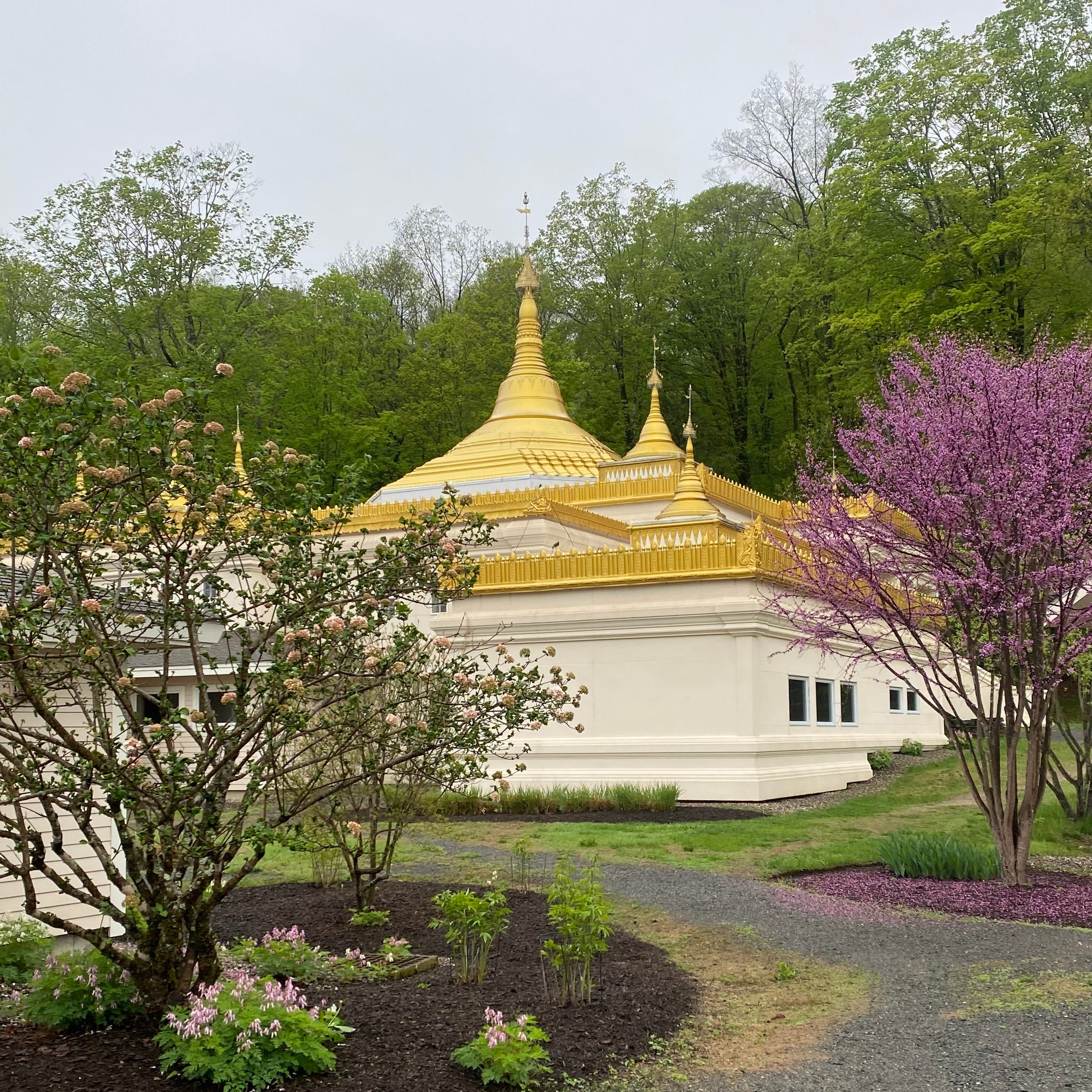
The usual Vipassana offering is the ten-day course, to which new and old students alike are welcome; enrollment in the eight-day Satipatthana Sutta is restricted to students who have sat the ten-day course three or more times. In timetable and structure, they are exactly the same; besides their relative length, the only other major difference between the ten-day and Sati courses is that while on the former, reading and writing are prohibited, while students on a Sati course read and study the Mahāsatipaṭṭhāna Sutta, or the Great Discourse on the Establishing of Awareness. Also, I have a bit of chip on my shoulder in re: calling these experiences “retreats”.
Video recordings of lectures on the meditation technique and on the central concept of Dhamma, which were originally given by the teacher, S.N. Goenka, in the early 90s.
Every center I’ve sat or volunteered at in the U.S. serves oatmeal and stewed prunes at breakfast, which is the real reason I go to sit these courses.
Not necessarily to impute dogma to these or other traditions—about which I know admittedly little.
How would I explain this? In meditation, I encounter a fundamental (real, irreducible, cellular) experience of impermanence. Through this experience, I develop an enduring awareness and understanding of impermanence that allows me to witness, with even just the most slightly increasing clarity or granularity, this constant causal phenomenon in which, essentially, things happen and I react. It dilates the time between stimuli and response.
As cited by my friend Zoë in her essay “Seedlings”, published in the collection they co-edited, Writing on Raving.